
Bias is an invisible force that subtly shapes how individuals interpret risk, often leading to distorted decisions that feel rational in the moment but are objectively flawed. In contexts ranging from gambling and investing to healthcare and everyday decision-making, cognitive biases play a critical role in how people perceive probabilities, outcomes, and consequences. Understanding these biases is essential because they do not merely affect isolated decisions; they create patterns of misjudgment that can accumulate over time, resulting in substantial losses, missed opportunities, or even catastrophic outcomes.
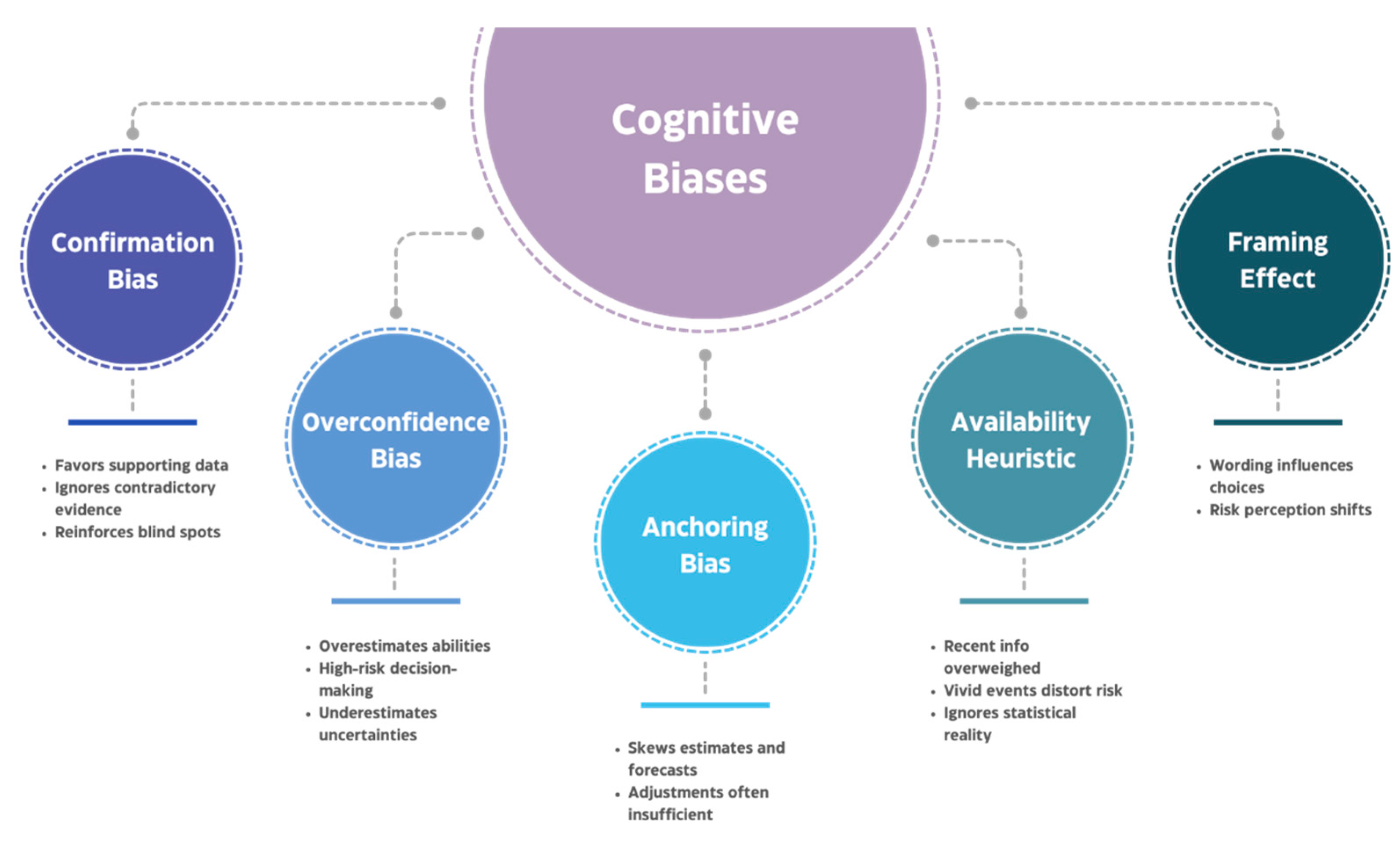
One of the most pervasive cognitive biases is the overconfidence bias, where individuals overestimate their knowledge, abilities, or the precision of their predictions. Overconfidence can make a person believe that they have better insight into risk than they actually do, leading to decisions that are excessively risky. In financial markets, overconfident traders may underestimate potential losses or overleverage positions, while in personal health, individuals may ignore warnings or overestimate their immunity to certain diseases. The distortion arises because the mind tends to overvalue personal experience and perceived competence, discounting statistical evidence that contradicts the perceived narrative.
Closely related is the confirmation bias, which drives people to seek, interpret, and remember information that confirms their preexisting beliefs while ignoring or undervaluing contrary evidence. This bias has profound implications for risk evaluation because it encourages selective attention. For instance, an investor who believes a particular stock will rise may focus exclusively on positive news and disregard warning signs, leading to a miscalculated assessment of potential loss. In safety-critical industries such as aviation or healthcare, confirmation bias can contribute to overlooking critical warning signals, amplifying risk rather than mitigating it.
The availability heuristic is another key mechanism through which bias distorts risk perception. This mental shortcut leads people to estimate the likelihood of events based on how easily examples come to mind. Dramatic or recent events are particularly influential. For example, after highly publicized plane crashes, travelers might overestimate the risk of air travel while underestimating far more common dangers like car accidents. Similarly, in gambling contexts, vivid wins can overshadow frequent losses, creating a skewed perception of probability and influencing riskier behavior than rational analysis would dictate.
Bias also manifests in the anchoring effect, where initial information serves as a reference point that disproportionately influences subsequent judgments. When evaluating risk, the first number, statistic, or anecdote encountered often becomes an unconscious benchmark. For instance, if an investor hears that a particular asset has risen 50% in the past year, they may anchor their expectations on that figure, even if market conditions indicate a significant downturn is likely. Anchoring can mislead decision-makers into underestimating potential downside, leading to distorted risk assessment and suboptimal strategies.
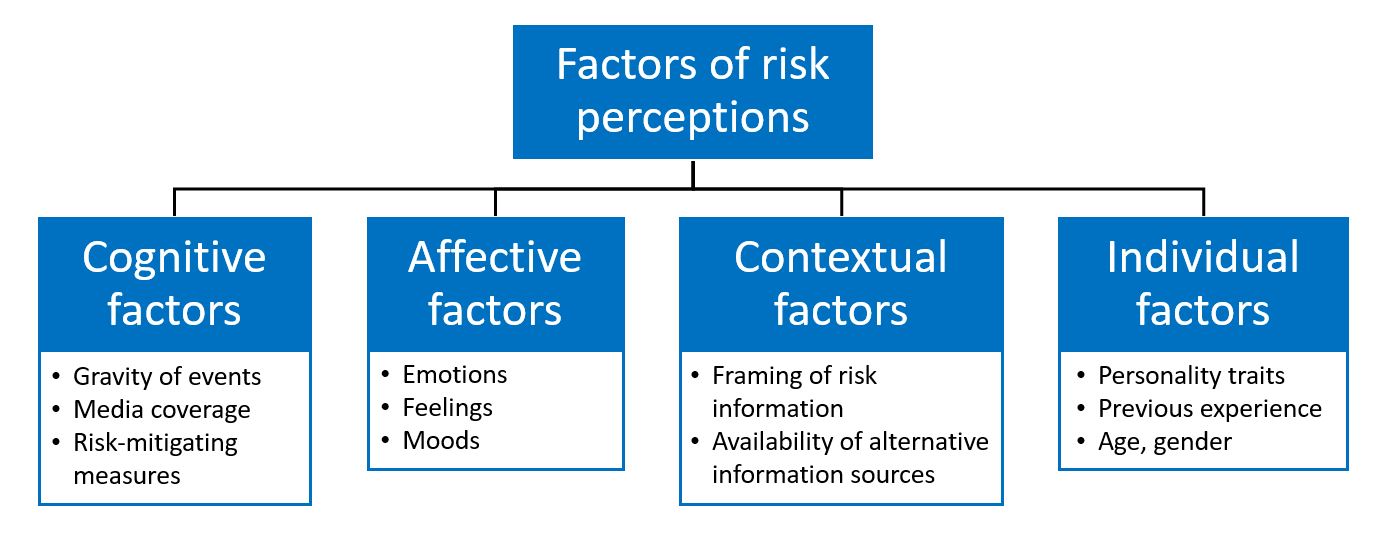
Emotional biases further complicate the evaluation of risk. Fear and greed are potent motivators that can override rational calculations. The loss aversion bias, where the pain of losses is psychologically more intense than the pleasure of equivalent gains, often leads individuals to make overly conservative or overly risky choices depending on the context. In gambling or investing, loss aversion can cause a player to hold onto losing positions longer than advisable or to overcommit when chasing previous losses, creating a cycle of irrational behavior. Emotional responses to perceived threats or rewards distort objective evaluation, making it difficult to act in accordance with statistical realities.
Group dynamics introduce another layer of bias. The herding effect occurs when individuals mimic the behavior of others, assuming that collective action reflects correct judgment. This is evident in financial bubbles, where investors pile into overvalued assets simply because others are doing so, or in public health scenarios, where people follow popular trends in behavior regardless of evidence. Herding can amplify risk misperception because it replaces personal analysis with social cues, often leading to synchronized errors that magnify the impact of bias on decision outcomes.
Mitigating bias in risk evaluation requires both awareness and structured approaches. Quantitative methods, such as probabilistic modeling, scenario analysis, and sensitivity testing, provide tools to counter subjective distortions. Decision frameworks that require explicit justification for assumptions and predictions can reduce reliance on gut feelings and anecdotal evidence. Moreover, training programs that highlight common cognitive biases and encourage reflective thinking can improve judgment by making individuals more conscious of automatic mental shortcuts.
Technology also offers avenues to counter bias. Data analytics platforms and predictive modeling tools can present risk in more objective terms, revealing patterns that human cognition might overlook. In gambling or financial trading, algorithmic assessments can highlight deviations between perceived and actual probabilities, guiding users toward more rational strategies. However, technology is not a panacea; it must be coupled with critical thinking, transparency, and accountability to ensure that reliance on tools does not introduce new forms of bias, such as overreliance on algorithms or misinterpretation of outputs.
Cultural and educational factors influence the susceptibility to bias as well. Societies that emphasize probabilistic reasoning, critical thinking, and statistical literacy tend to foster individuals better equipped to evaluate risk accurately. Conversely, environments that reward intuition over evidence or that propagate myths and anecdotal success stories reinforce biased judgments. Education that combines theoretical knowledge with practical application, such as simulations and case studies, can cultivate an ability to recognize and correct bias before it materially affects decision-making.
Ultimately, bias distorts risk evaluation because it shapes the lens through which information is filtered, interpreted, and acted upon. Whether through overconfidence, selective attention, emotional interference, or social influence, these cognitive distortions create gaps between perception and reality. Addressing bias is not about eliminating human judgment—it is about enhancing it, creating systems and habits that allow for more accurate, measured, and rational assessments of risk. By understanding and mitigating bias, individuals and organizations can make decisions that are more resilient, sustainable, and aligned with objective probabilities, reducing the likelihood of costly errors and enhancing long-term outcomes.




Leave a Reply